Ever stopped and thought about where your favorite animated cartoons or animated movies came from? Indeed, the world of animation is quite extensive and exciting in itself, incorporating all the diverse techniques that bring life to static images. This blog post will take you through the wonderful world of types of animation – from the conventional ways of hand-drawn techniques to state-of-the-art 3D technology. This column aims to explain the kinds of animation and the basic characteristics that distinguish them. It can be of great value to anyone who is interested in learning about animation, even if it may only be as a viewer.
Introduction: What is Animation?
Animation is the technique of creating the illusion of movement by creating a sequence of static images that are displayed in rapid succession. It’s almost like magic for your eyes. If these images are flashed enough quickly, our brains interpret them as continuous motion. This principle is what all types of animation rely on, from the simplest flipbooks to the most complex computer-generated movies.
The Evolution of Animation
Animation is colorful in history, just as cartoons. Let us take a very brief journey down memory lane and trace the evolution of different types of animation:
- Early forms: Animation began with simple devices like the zoetropes and flipbooks. These basic tools led to more advanced techniques.
- Stop-motion pioneers: With the advent of stop-motion in the late 19th century, the world saw three-dimensional objects living in one frame at a time.
- The rise of cel animation: Walt Disney revolutionized the industry in the 1920s and 1930s with cel animation, producing beloved classics like “Snow White and the Seven Dwarfs.”
- The digital revolution: The computer-sitting scenario dictates a dramatic change in the world of animation from the 1990s and 2000s, which dominated 3-D computer-animated films with Pixar as a pioneer.
- Modern diversity: With advancements in technology, the industry has witnessed the emergence of new animation types along with traditional methods.
The 5 Major Types of Animation
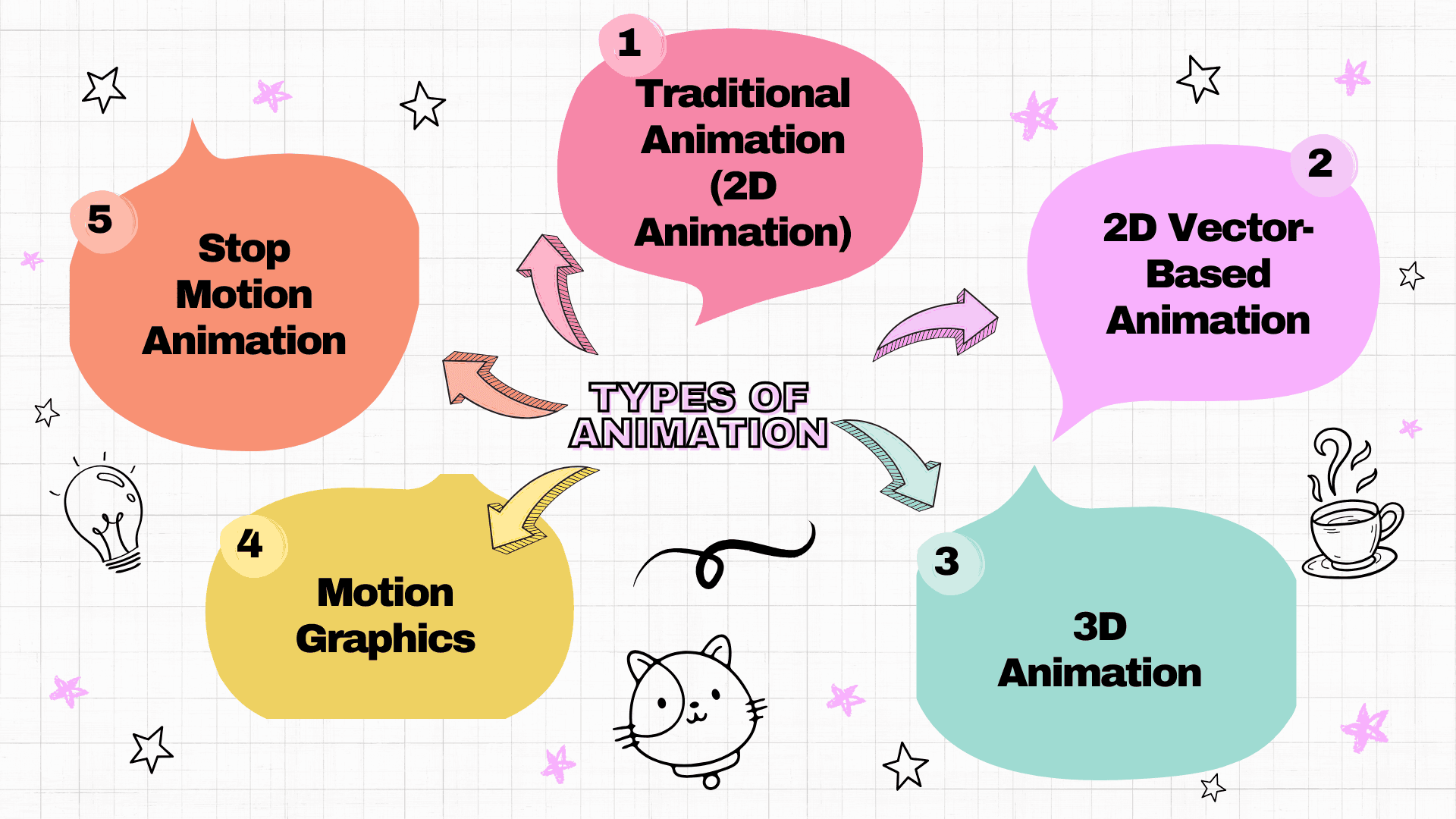
Now, let’s dive into the main types of animation you’ll encounter in movies, TV shows, and other media.
1. Traditional Animation (2D Animation)
Traditional animation or 2D Animation, also referred to as cel animation, is considered the grandpa of all the animation types. You’ll know this when you get to know it:
- What is it: Animators hand-draw each frame, so when played in sequence, they create the illusion of movement.
- How it’s made: Animators will draw on transparent sheets called cels then photograph them over a painted background.
- Where you’ve seen it: Classic Disney movies like “The Lion King” and “Aladdin.”
- Cool fact: A single second of animation can require up to 24 unique drawings!
2. 2D Vector-Based Animation
But 2D vector animation is like the hip, tech-savvy cousin of traditional animation. Here’s the way to break it down:
- What is it: It is simply the use of computer software, which produces smooth, scalable animations without any loss of quality.
- How does it differ from traditional animation: You can easily resize and manipulate elements without redrawing them.
- Where you might have seen it: Many web animations and modern cartoons.
- Fun fact: Vector animation is just perfect for achieving fluid designs that are responsive on all screen sizes.
3. 3D Animation
3D animation is the rock star of contemporary animation types. So, let’s break down what it is about.
- What is it: It creates characters and their environments in a virtual 3D space with depth and realism.
- How it is done: Artists use specialized software for modeling, texturing, and animating 3D objects.
- Where you’ve seen it: Pixar movies, video games, and even some TV commercials.
- Mind-blowing fact: A single character in a 3D animated film can have hundreds of controls to manipulate its movement!
4. Motion Graphics
Motion graphics are those cool animations you typically see within advertisements or presentations. Here is what makes motion graphics different:
- What is it: It is the combination of graphical design elements, text, and movement to convey ideas or information.
- How it’s used: Often for explanatory videos, title sequences, or infographics.
- Where you’ve seen it: All those intros to TV shows, the animated news graphics, and the cool animated logos in commercials.
- Pro tip: Motion graphics are great for taking complex information and making it easy to understand and remember.
5. Stop Motion Animation
Stop motion is like the patient artist’s animation technique. Here’s why it’s so unique:
- What it is: Physical objects are moved in small increments and photographed to create the illusion of movement.
- Types of stop motion:
- Claymation: Using clay figures (think “Wallace and Gromit”)
- Puppet animation: Using jointed puppets or dolls
- Cut-out animation: Moving flat paper or cardboard characters
- Where you’ve seen it: Movies like “Coraline” or “The Nightmare Before Christmas”
- Wow factor: Some stop-motion animators spend an entire day to create just a few seconds of footage!
Emerging and Hybrid Type of Animation
The world of animation is always evolving. Here are some exciting techniques that blend different animation types:
Rotoscoping
Rotoscoping is like tracing over reality to create animation:
- What it is: Animators trace over live-action footage to create realistic movements.
- How it’s used: To create lifelike animations or to add animated elements to live-action films.
- Cool examples: The movie “A Scanner Darkly” used rotoscoping to create its unique visual style.
Motion Capture (MoCap)
Motion capture brings real human movements into the digital world:
- What it is: Recording an actor’s movements and applying them to a digital character.
- How it works: Actors wear special suits with sensors that track their movements.
- Where you’ve seen it: Films like “Avatar” and many modern video games use motion capture.
- Fun fact: Some mocap suits can even capture facial expressions!
Virtual Reality (VR) Animation
VR animation is the newest frontier in immersive storytelling:
- What it is: Creating animated environments and characters that viewers can interact with in virtual reality.
- How it’s different: It allows viewers to be part of the animated world, not just watch it.
- Exciting applications: VR animations are used in gaming, education, and even therapy.
Choosing the Right Types of Animation
Picking the perfect animation type for your project is crucial. Here’s a quick guide:
The right animation type for your project has to be selected. Here is a quick list:
- For narrative use, traditional 2D or 3D animation typically is the best.
- To make complicated ideas simple, motion graphics or 2D vector animation may be of great help in making difficult concepts appear easier than ever.
- Using stop motion or rotoscoping to give it an artistic look that is uniquely different.
- For natural motion, resort to 3D animation or even the famous motion capture.
Don’t forget the budget and time frame, either, because not all animations are the same when it comes to cost and time.
Tools and Software For Each Type Of Animation
Every animator has their favorite tools. Here are some popular choices for different animation types:
- Traditional Animation: Toon Boom Harmony, TVPaint
- 2D Vector Animation: Adobe Animate, Moho
- 3D Animation: Blender (free!), Autodesk Maya, Cinema 4D
- Motion Graphics: Adobe After Effects, Apple Motion
- Stop Motion: Dragonframe, Stop Motion Studio
- Motion Capture: Vicon, OptiTrack
Common Mistakes To Avoid When Creating Animation
Even the pros make mistakes sometimes. Here are some pitfalls to watch out for:
- Don’t try to overcomplicate your animation. Sometimes, the simpler, the better.
- Your animation style must be suitable and align with your message and audience.
- Do not forget about sound. Great audio can make or break an animation.
- Keep yourself updated with the latest developments in software and techniques that can make your animations look fresh.
Conclusion
We have seen the beautiful diversity of animation types, from old classic hand drawings and into high-tech VR. Every kind of animation brings with it a distinct flavor and utility because this field is constantly evolving through innovative new technologies and creative ideas.
Then, if you are ready to take the leap into the world of animation, then Ice N Fire Media is here for you. Our team of experts in animators specializes in all the different animation types we spoke about. Whether a smooth motion graphics video to promote a business, an adorable 2D cartoon for your YouTube channel, or a visually stunning 3D animation for your next big project, we’ve got it all ready for you.
At Ice N Fire Media, we don’t just create animations – we bring your ideas to life. Our best facilities and cutting-edge software allow us to produce high-quality animations in any style you desire. Plus, our team stays up-to-date with the latest animation types and techniques, ensuring your project will always be at the forefront of animation technology.